Agroecology

Climate- resilient villages & Food security

Rural Development

Gender Equality, Youth & Social Inclusion

Nutrition, Health, & WASH

Reproductive & Medical Care

Poverty reduction, Livelihoods & Jobs

Technology integration: GIS, Biodiversity/Carbon Monitoring

Education & Training
Research conducted on Sustainable Agricultural Transitions in India
This summary reports research conducted over eleven months of research (from September 2020- July 2021) amongst farmers in Haryana villages in the northwest part of the country
Research conducted on Sustainable Agricultural Transitions in India
This summary reports research conducted over eleven months (from September 2020- July 2021) amongst farmers in Haryana villages in the northwest part of the country. Drawing primarily on qualitative research methods such as interviews, small group discussions and participant observation, the research focused on the changing character of farming in Haryana, specifically the transition to diverse agricultural approaches in farming practices. The overarching aims of my study were three-fold: first, to examine the evolving conditions that shape farming practices in Haryana; second, to explore the everyday opportunities and challenges posed by transitions to alternative farming practices; and third, to examine the social implications of these transitions at the household and community levels.
Most transitions to alternative agricultural approaches in India are proposed in response to growing socio-ecological concerns because of Green Revolution (GR) technologies and policies. However, it is worth noting that not all responses to intensive agriculture are claimed to be sustainable at any given time. Globally, two alternative approaches to intensive agriculture emerged during the late twentieth century and tried to address the question: Why and how do people change the way they practice agriculture? Scholars arguing for ‘ecological modernisation’ believed in using sustainable technologies in modernising agriculture rather than a complete rejection of industrial forms of agriculture. To them, this could be done by exploring the relationship between farmers’ attitudes to sustainable agricultural practices and investigating the potential diffusion of knowledge between various stakeholders. On the other hand, scholars proposing ‘agroecological approaches’ believed in maintaining food production without degradation of resources in the long run by using local resources and knowledge, low-input technologies, maximising recycling, diversifying production, and enhancing biological pest control. There was also an increasing realisation that many new forms of farming were necessary with changing times, and these must be ecologically sustainable, diverse, local, and socially just. Most proponents of agricultural transitions in India focus on ecological sustainability, that emphasises the regeneration of degraded agricultural land and natural resources depending on the local farming conditions. However, studies have produced limited knowledge about different aspects of agricultural transitions at the regional and farm-level, especially encompassing the social outcomes of transitions and decision-making processes of change. By incorporating farm-level perspectives on social processes and outcomes of transitions, my research helps mitigate the existing dearth of literature in this area.
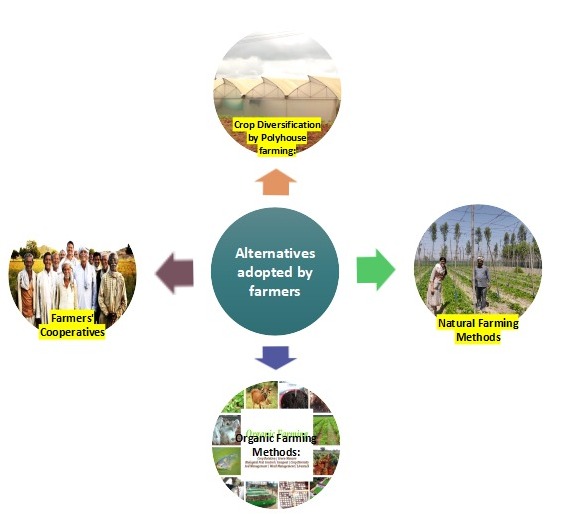
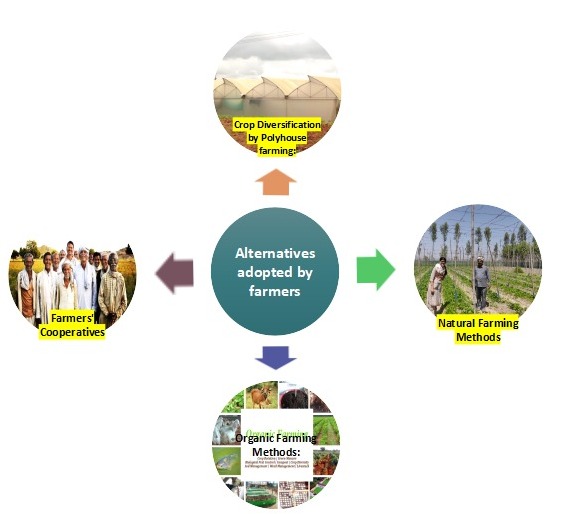
Moreover, agricultural transitions are processes where most farmers are at different stages, making it difficult to study diverse farming practices and the social implications of transitions at the macro or village level. This demands a study at the household or community level that can understand nuances at a micro level to analyse different farming practices, management strategies, and emerging meanings of sustainability. In this research, I examine farmers’ perspectives and their ‘diverse pathways to transition’ to understand the variety of knowledge-intensive farming systems and practices that have emerged from agricultural transition processes. To do so, I attempt to build on the multifunctional agriculture (MFA) framework and an actor-oriented approach to study agricultural transitions, transitioning processes, and their outcomes in different geographical, social, economic, and cultural contexts. My research reveals that different farmers follow diverse farming practices and management strategies at the farm-level. These farming practices range from using chemical inputs in polyhouse farming to a strict organic farming method following a complete ban on chemical inputs. The marketing strategies range from short-distance sales of produce or growing for self-consumption to marketing at wholesale and high-end supermarkets, with the transition to food-processing industries within villages. Studying these diverse pathways to transition helps conceptualise agricultural transitions as a range of dynamic practices and processes of change in a given socio-economic context.
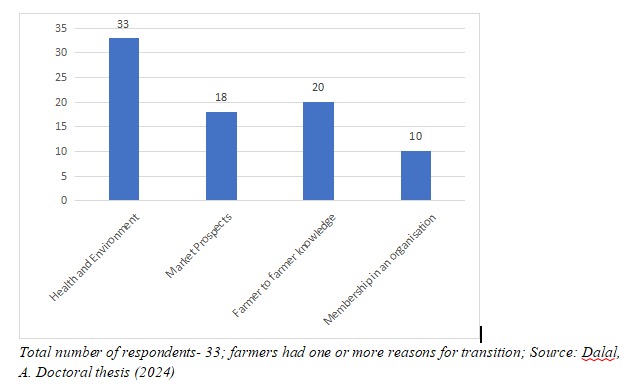
Finally, to examine the social implications of these transitions, I analyse farmers’ perspectives on why and how they transition to diverse agricultural approaches in the villages. On the question of why some farmers adopted alternative farming methods, this study focused on the motivation and experiences of farmers who have shifted from a conventional mode of farming to other practices. Specifically, my research reveals that the main reason farmers change their whole farming style starts with their concerns about health and the environment and goes further once economic, social network and informational gaps are being dealt with. Within these themes, I also analyse why different farmers perceive these factors as an opportunity or a challenge in transition. For instance, in terms of market and economic prospects, some farmers perceived the economic incentives of selling organic food to high-end supermarkets as a motivating factor to adopt organic farming practices. Yet, some others felt marketing challenges such as lack of social network, separate organic market, low premium, and interference of middlemen were demotivating factors in transition. Finally, my research examined two other challenges—agronomic and informational gaps and negative pressure from friends and family—and discussed how these factors led to some thwarted transitions.
Furthermore, on the question of how different farmers transition to diverse farming methods, my research reveals that, though most farmers decided to transition at an individual level, others preferred to do group farming through cooperatives and found it much easier to do ‘farming in unity’. Many other factors, such as existing economic resources, social networks, and their social and gender positions within a rural community, had an impact on who was able to transition more smoothly than others. Yet, these transitions were not limited to any particular socio-economic group of farmers. Caste, class, gender, and age groups emerged as important categories to examine who adopts what kind of farming practices and how they define their own visions of sustainability. For example, I explored the category of new farmers or reverse migrants who had returned to their villages to find career prospects in sustainable farming. These farmers claimed themselves to be organic farmers and defined sustainable agriculture not just through ecological practices to rejuvenate degrading land and soil fertility but also to create equal opportunities for other farmers to learn and adopt these practices. They asserted that sustainable farming might be an individual farmer’s struggle, but a collective effort was required to bring about substantive change in society and among rural farming communities. Finally, by focusing on different forms of farming methods emerging across diverse groups of farmers, I argue that farmers’ specific attributes to farms and farming practices are important for understanding the complexity of agricultural transitions in the given socio-economic context.
Overall, the research argued that although diverse farming practices were adopted to transition to alternative agriculture, their pathways to transition differ in terms of the strategies adopted and the socio-ecological outcomes they generate for different groups of farmers. Studying these models by recognising different pathways to transition is important in developing an alternative framework to understand sustainable transitions that acknowledge place-based differences and knowledge of farming practices that are crucial at a given time and may be suitable in the current socio-economic context in India.
Factors of motivation
Author (Anjali Dalal, PhD Lead Researcher, Climate Change and Agriculture)
Research conducted on Sustainable Agricultural Transitions in India
Moreover, agricultural transitions are processes where most farmers are at different stages, making it difficult to study diverse farming practices and the social implications of transitions at the macro or village level. This demands a study at the household or community level that can understand nuances at a micro level to analyse different farming practices, management strategies, and emerging meanings of sustainability. In this research, I examine farmers’ perspectives and their ‘diverse pathways to transition’ to understand the variety of knowledge-intensive farming systems and practices that have emerged from agricultural transition processes. To do so, I attempt to build on the multifunctional agriculture (MFA) framework and an actor-oriented approach to study agricultural transitions, transitioning processes, and their outcomes in different geographical, social, economic, and cultural contexts. My research reveals that different farmers follow diverse farming practices and management strategies at the farm-level. These farming practices range from using chemical inputs in polyhouse farming to a strict organic farming method following a complete ban on chemical inputs. The marketing strategies range from short-distance sales of produce or growing for self-consumption to marketing at wholesale and high-end supermarkets with the transition to food-processing industries within villages. Studying these diverse pathways to transition helps conceptualise agricultural transitions as a range of dynamic practices and processes of change in a given socio-economic context.
Finally, to examine the social implications of these transitions, I analyse farmers’ perspectives on why and how they transition to diverse agricultural approaches in the villages. On the question of why some farmers adopted alternative farming methods, this study focused on the motivation and experiences of farmers who have shifted from a conventional mode of farming to other practices. Specifically, my research reveals that the main reason farmers change their whole farming style starts with their concerns about health and the environment and goes further once economic, social network and informational gaps are being dealt with. Within these themes, I also analyse why different farmers perceive these factors as an opportunity or a challenge in transition. For instance, in terms of market and economic prospects, some farmers perceived the economic incentives of selling organic food to high-end supermarkets as a motivation factor to adopt organic farming practices. Yet, some others felt marketing challenges such as lack of social network, separate organic market, low premium, and interference of middlemen as demotivating factors in transition. Finally, my research examined two other challenges — agronomic & and informational gaps and negative pressure from friends and family — and discussed how these factors led to some thwarted transitions.
Furthermore, on the question of how different farmers transition to diverse farming methods, my research reveals that, though most farmers decided to transition at an individual level, others preferred to do group farming through cooperatives and found it much easier to do ‘farming in unity’. Many other factors, such as existing economic resources, social network, and their social and gender position within a rural community, had an impact on who was able to transition more smoothly than others. Yet, these transitions were not limited to any particular socio-economic group of farmers. Caste, class, gender, and age groups emerged as important categories to examine who adopts what kind of farming practices and how they define their own visions of sustainability. For example, I explored the category of new farmers or reverse migrants who had returned to their villages to find career prospects in sustainable farming. These farmers claimed themselves to be organic farmers and defined sustainable agriculture not just through ecological practices to rejuvenate degrading land and soil fertility but also to create equal opportunities for other farmers to learn and adopt these practices. They asserted that sustainable farming might be an individual farmer’s struggle, but a collective effort was required to bring a substantive change in society and among the rural farming communities. Finally, by focussing on different forms of farming methods emerging across diverse groups of farmers, I argue that farmers’ specific attributes to farms and farming practices are important for understanding the complexity of agricultural transitions in the given socio-economic context.
Overall, the research argued that although diverse farming practices were adopted to transition to alternative agriculture, their pathways to transition differ in terms of the strategies adopted and the socio-ecological outcomes they generate for different groups of farmers. Studying these models by recognising different pathways to transition is important in developing an alternative framework to understand sustainable transitions that acknowledge place-based differences and knowledge of farming practices that are crucial at a given time and may be suitable in the current socio-economic context in India.
Factors of motivation